Sunday, 7 June 2015

30 Days Wild #Day 6

After a wild week at work it was time for some down time today and I can't think of anything better than spending some time in my own special piece of the countryside, my patch at Barmston. Here I indulge my Patchwork Challenge efforts on the interface between East Yorkshire and the North Sea.


The wind whipped the sand into the air but I was looking for something else entirely - Bee-eaters. Five had been seen by Martin Garner early on at Flamborough and the same birds roosted in a Bridlington garden for half an hour mid-morning. Alas despite a heavy southerly passage of Swifts it was not to be with the highlight half a dozen House Martins hawking over 'big hill'.


Patchwork Challenge is a birdwatching competition which I help to run. The aim is to see as many species as you can in a year on your patch - 3km2 shaped and located wherever you want. I chose my closest coastal strip and today as well as adding House Martin I also got my first Greylag and Canada Geese of the year. I've been watching Barmston for about three years with many occasional trips beforehand so I have amassed a reasonable list of birds seen there and have seen a handful of scarce and rare birds. One of the best things about patch watching is raising the ordinary to extraordinary through context and today I managed to see a small white heron called a Little Egret on the drain that marks the northern boundary. This species has over 1000 breeding pairs in the UK and is relatively common but this individual was my first at the site. And very special it was too. Less than 20 years ago Little Egrets didn't breed in the UK and in the interim their population has exploded after colonising from Brittany. Plus ca change in my opinion.


Less special for my patch but far more important on a national level were 8 (eight) male Corn Buntings holding territory  dotted around the north of the patch.  These rambunctious, fat and chirpy characters have had somewhat different fortunes to the Little Egret with the population crashing at an alarming rate due to changes in agricultural practice so it was great to hear their song rattling out from a number of vantage points.

2015 has been an average year so far with a productive late winter but poor spring and I find myself on 95 species. Not too bad, not particularly good. A Four-spotted Chaser may not have added to my score but was the first dragonfly of the year for me.

Friday, 5 June 2015

30 Days Wild #Day 5


Today was a fantastic day in Cumbria and North Yorkshire. A mild and still morning greeted me at 4.30am as I headed out to do a breeding bird survey. Now we are so far through the breeding season, song is more muted but I still got a superb variety recorded on this pleasant site.

The best bird was definitely the Spotted Flycatcher that was flying around the top of a Scots Pine. It was my first of the year and a species in a steep decline so it's always good to find them on territory. Aside from this two pairs of breeding Buzzards were great to watch as the crows chased them over the meadows. I also found a small heronry which gives the incongruous views of these gangly hunters perched in treetops.


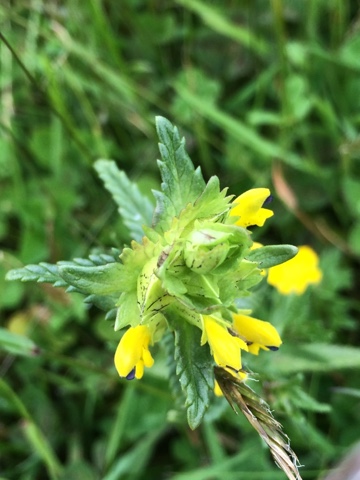
The CBC methodology for surveying birds involves lots of walking and today I managed to crank out 15 miles. I felt great and made quick progress. I was able to enjoy the wild flowers of the meadows thanks to getting ahead of schedule and noted lots of Early Purple Orchids and Yellow Rattle amongst the endless Buttercups, Red Campion and Herb Robert. The warm air also brought with it my first Painted Lady of 2015. These gorgeous orange and black butterflies can be elusive or commonplace. What sort of year will 2015 be for them? I'm going to be doing the butterfly survey on my bbs tetrad so maybe we shall see!


After I finished I headed home and I staged at Sutton Bank for a rest. A stroll to the viewpoint gave me amazing views of the vale of York and the dales looking hazy in the distance. Gliders circled on thermals like giant raptors in silence except for the wind whipping over their wings. Siskins called and several warblers sang but my heart lifted truely at the brief site of two doves. Two special doves, fresh in from Africa. Two Turtle Doves which have a relative stronghold in the area flew over the visitor centre. These guys are heading for extinction in the UK with massive declines over my lifetime and they have gone missing from swathes of the countryside thanks to a combination of changed agricultural practises, hunting pressure and less food in wintering areas. Forest edges like Sutton Bank are proving valuable enclaves for this beautiful dove with the distinctive purring call.

The final perk of the day was a gravid female Common Lizard which shot across the path toward me and his in plain sight before scurrying away. What a way to round off the day and the first 5 days of 30 days wild.

30 Days Wild #Day 4

I'm sure I should be posting some of the outstanding seascapes I saw today from the bird and marine mammal survey in the Irish Sea or perhaps the dramatic choppy water with flocks of Manx Shearwaters zipping about or even the diminutive fin of a Harbour Porpoise disappearing into the blue. But no, I was too busy counting, recording, chivvying and generally being busy. An early start (pre-5am should be banned) and the buffeting of the sea as a mild swell catching us on the corner made life uncomfortable and a number of those less experienced with this sort of thing turned decidedly green.

I am however blessed with a reasonable constitution and haven't yet had issues with mal de mer. Because of this I was able to enjoy a bevy of common seabirds including Gannets, Guillemots, Kittiwakes, Common Scoter and my first Arctic Tern of the year along with those sights noted above. Great fun but now I'm a little tired!

Tomorrow I am off to undertake a breeding bird survey in the North-west. Fingers crossed for a nice morning and some decent sightings.

Wednesday, 3 June 2015

30 Days Wild #Day 3


Today I visited Burton Mere RSPB to see my friend Ray. He hasn't been so well so it was great to see him looking good and even better there was a summer plumaged Red-necked Phalarope spinning around like Kylie amongst the Black-tailed Godwits. There was loads of Hemlock Water Dropwort aside the reedbed which was a new plant for me. Additionally there was a Willow Warbler which is apparently a very good record for the site.


Aside from visiting Ray I was working on the fringes of the Peak District this morning undertaking wader and raptor surveys on the moorland farmland interface. 


Despite early rain the soundtrack of Curlew and Lapwing soon echoed around the valley as Crows were sent packing presumably to protect chicks hiding in the long sward of the meadows. My first Cuckoo of the year sang it's repetitive di-syllable from wires away to the north. 


Moving to another site above a reservoir and the slightly ropey weather managed to keep activity to a low level but a pair of foraging Buzzards induced an angry reaction from a nesting Kestrel on a cliff. The Buzzards escaped with all their tail feathers still attached but only just. More prosaic but higher in the cute stakes were the troupes of lambs which were at that cute and chubby stage. 

A great day and fab to catch up with Ray for the first time in a couple of years. Day 4 should feature seabirds and perhaps porpoises as I work off the Cumbrian coast.

Tuesday, 2 June 2015

30 Days Wild #Day 2


This afternoon the rain abated and the temperature shot up so I decided to take 40 minutes away from my work data and head a mile down the road to Snakeholme Pastures YWT. This seemingly unremarkable and small nature reserve is a little gem and one which I am just scratching the surface on. It is a couple of meadows with small pools set between chalk streams and the Driffield Canal and holds a surprising array of wildlife.


One of the biggest surprises was my first sighting of an adult Marsh Frog. This species is introduced and has spread along the river from Tophill Low but it is very impressive with its belching call from its twin airsacs. It is larger than our native Frog and is more uniform green with a lime stripe down its back. I was investigating the Ragged Robin pictured above when a frog started belching at my feet. I had marvellous views but disappointingly it decided to submerge as I attempted to capture it for posterity on film.

By this time I had given up on the special fish which are present in the chalk streams due to the high winds riffling the surface and making spotting them impossible. I am yet to see the Brook Lampreys here but I am assured they do occur. This species has no jaw and is one of the most prehistoric of fish, foraging by  attaching themselves with their sucker like mouth to a fish and then eating lumps from its victim. Next time...


I did find this rather cute Sawfly, Arge pagana or similar hanging onto the Meadow Buttercups. Plenty of small invertebrates including the golden micro-moth Glyphipteryx simpliciella were about. These guys are out en masse and I suggest you google them as close up they are stunning jewels despite only being 1-2mm long. I also turned up a Downlooker Fly, Rhagio scolopaceus on a Dandelion.


Aside from the invertebrates there were also plenty of flowers out and aside from the common umbellifers and Red Campion there was plenty of Charlock and a presently mysterious umbellifer which resembled Pig-nut. We shall see.

That was Day 2 and Day 3 sees me doing wader and raptor surveys in the Peak District.

30 Days Wild #Day 1

I have signed up to 30 Days Wild to do something Wild everyday in June. Not too hard for an enthusiastic amateur Naturalist and jobbing Ornithologist you may say. Perhaps but it reminds me to engage all the time and to get my girls to engage as well.


Day one had me monitoring a schedule one breeding bird. I just hadn't been told what it was! Imagine my delight when a pair of Peregrines saw off a Buzzard and circled over their nest site in the East Midlands. Away from here I managed to find this gorgeous Malachite Beetle Malachius bipustulatus. It was hiding on a Spear Thistle Cirsium vulgare. The beetle is a mini-predator, hunting amongst the flowers and has a decent pair of jaws that can be seen in the photo. Sadly the planned afternoon looking for inverts disappeared thanks to the weather. If the rain ever stops then I will do that today!

Tuesday, 26 May 2015

Pan-ic at the Disco

My pan-species listing malarkey has surged onwards to 816 species with many recent additions. Slow Worm is probably the most notable (not sure I can count heard only Natterjacks) but it has also included the rather cool Nomada marshamella Marsham's Nomad Bee and Cercopis vulnerata Black-and-red Froghopper. Here are a few photos of bits and pieces.

Black-and-red Froghopper Cercopis vulnerata

Alderfly Sialis sp.

Garden Tiger Moth caterpillar

Click Beetle sp.

Rhingia campestris

Glyphipteryx simpliciella
Marsham's Nomad Bee Nomada marshamella
Larinioides cornutus
Nomada sp. Nomad Bee

Slow Worm
Andrena sp.
Germander Speedwell


How birds and brains become mutually exclusive

Record, share and compare with BUBO Listing at www.bubo.org