Saturday, 31 March 2018

Australia Trip Report Part 2: Canberra and surrounds


I woke refreshed having been so tired that the small hours didn't get witnessed. A bonus of crashing out early was I was up at 6 for dawn. A revitalising coffee and I watched from Tom's back deck. It was cool, in the early teens (perhaps the coolest time of the whole trip). Australian Magpies and Pied Currawongs sung from all around. Amongst the Crimson Rosellas were a brace of Eastern Rosellas. The raucous calls of Sulphur-crested Cockatoos spread over the neighbourhood as they left roosts. Starlings swirled over the neighbourhood as they left the reedbeds of central Canberra. In the garden a Silvereye moved through - my first whiteeye sp. After breakfast Tom led me along the slopes of Big Monk, the mountain that looks over Banks. We flushed a Blackbird and the whir of wings gave away a pair of Crested Pigeons.

Common Myna from my brothers garden
Crested Pigeons along with a Magpie Lark
One of many Galahs
Silvereye
 After lunch we headed to Tidbinbilla, a forest reserve in the Brindabellas. It is huge and draped over a range of mountains. On the way we were surprised by an Echidna crossing the road! Not something I was expecting to see and my brothers first.


Echidna doing hiding.
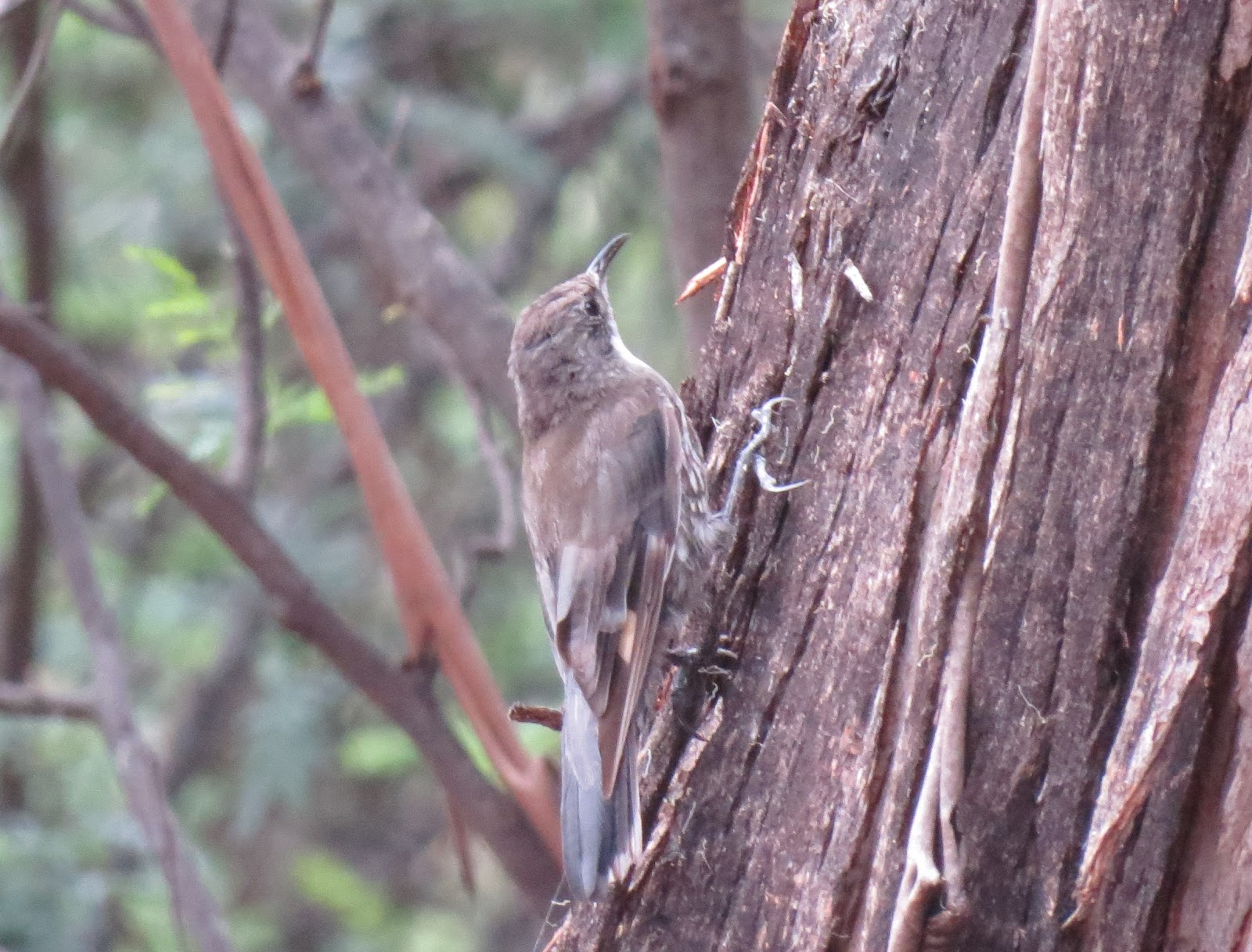
On the way in the reintroduced Emus were knocking about the entrance. These were thought killed in forest fires several years ago but persisted and recolonised. We went for a walk around the Sanctuary which has a collection of Black Swan, Brolga, Musk Duck, a Pelican and Magpie Geese. Some of these caught me out initially but I was soon square. More genuine were a couple of Little Pied Cormorant, Australasian Swamphen, some Grey Teal and my first Dusky Moorhen. The latter were pretty much dull Moorhens. In the trees an Eastern Yellow Robin was looking very smart and my first Spotted Pardolote. A White-fronted Treecreeper was like an oversize Certhia in behaviour. A couple of Satin Bowerbirds flew through the canopy - these were much larger than I expected. A couple of Yellow-faced Honeyeaters were the first of several through the trip. We looked for Black Snakes and Platypus but struck out. We did find some herp interest with Eastern Long-necked Turtle, Shingleback Skink Yellow-bellied Water Skink and Eastern Water Dragon. Several Kookaburras laughed as they flew between perches. The Sanctuary is a wet area which is managed for a number of species with pools and ponds created through slowing the water. There are also pots of gums and eucalypts plus some rocky areas in a small valley.

Australasian Swamphen
Upon leaving we had a drive round the rest of the reserve. A snake was warming itself on the road over a stream. It was seen late as it was dark backed and white underneath with copper between the back and belly. We stopped just in time but couldnt see it. Tom asked me to hop out to check it wasn't wrapped around the wheels - I was all too keen as I wanted better views of this hyper-venomous super elapid! Sadly when I disembarked the Highland Copperhead was nowhere to be seen - it must have snuck off at the last second. I was understandably a little ginger when looking about as it is one of the most venomous snakes in the world and this gave it the opportunity to slope off.

Eastern Long-necked Turtle


Spotted Pardolote

White-throated Treecreeper

Yellow-bellied Water Skink

Yellow-faced Honeyeater

Thursday, 29 March 2018

Australia Trip Report: Part 1


The Beast from the East arrived in the UK with ice in its heart and a bag load of snow in its clouds. Apparently. I was in the Valleys in South Wales watching Red Kites and whilst it was freezing cold (-8c most of the time) I was happily avoiding most of the precipitation and getting excited about my imminent trip to Australia. And then bang - red warning of snow for Bristol Airport for when I was flying back to Newcastle. Flights cancelled, new hire car and 500 miles later I am back at home via Newcastle. I'd escaped the South-west before the big fall but I'd seen how much was out East. The Pennines however were shut. The following day and I'm packed and ready to roll on my Australian adventure but still there was no way across the Pennines - M62 shut, A66 shut, Cat & Fiddle shut, A69 shut, Snake pass shut, Woodhead pass shut. In the end I had to make a 100 mile detour south to Uttoxeter round the hills to get to Manchester but I arrived frazzled but ready. All this excitement meant that in the 25 hours of travelling that followed I didn't get a wink of sleep.


A Cold Welsh Hillside. The start of the journey


My sleep addled brain found this to be the most interesting part of Abu Dhabi Airport

A steady flight out to Abu Dhabi contained a couple of superhero films and little else. Arriving at the airport in darkness I waited around the gate after a coffee pep up scanning for birds. Obviously the first ones were Feral Pigeon and then Ring-necked Parakeet commuting from hidden roosts to feeding grounds nearby. Some House Sparrows lived inside the terminal, high above the people milling below. A brace of Laughing Doves were looking for tidbits cleared from the planes by the cleaners in the Etihad team. My first lifer of the trip were a pair of Common Mynas which flitted between the aircraft and that was it. Hardly mindblowing but good to get a lifer, albeit feral under the belt.

Straw-necked Ibis
The flight through to Melbourne was very long and uneventful and soon the sun was coming up in the terminal. Little Raven was my first Australian bird as a few messed about on the tarmac. Before long I was winging my way to Canberra on the last leg of the journey. I was greeted by my nephew who I was meeting for the first time, Patrick. He was far more interested in the planes than me (rightly so). Soon we were headed across town for some lunch. I was flagging after a beer with my burger but a walk round Lake Burley Griffin in central Canberra perked me up. Thousands of Flying Foxes were roosting in the park and the first Wood Ducks and Pacific Ducks were messing about along with Little Pied Cormorant and Silver Gull around the lake. Cockatoos were prevalent and a female Red-rumped Parrot was in a tree. Welcome Swallows were hawking over the lake. My first Straw-necked Ibis was wandering around the grass like a crow and there were plenty of Australian Ravens about. My first honeyeaters were Noisy Miners which shared the place with invasive Common Mynas.

Female Red-rumped Parrot - confused the life out of me to start
We drove back and a pair of Wedge-tailed Eagles were displaying over Banks, the suburb where my brothers family live. They were seen again from the decking and on and off throughout the trip. After a power nap Tom and myself headed out for a walk for a look over the neighbourhood. Here there were my first Kangaroos. Around the house were Willie Wagtails, Crimson Rosellas and Galahs. A family of Superb Fairy-Wrens chattered away nearby. Pretty soon jetlag got the better of me and I retired. This was the start of one of the best holidays I have ever had.


Sunday, 4 March 2018

Australia!

An eventful week with the weather tried to put spanners in the works but they failed! Im in Canberra and there are birds and 'roos and Flying Foxes. Its awesome. Here are a selection from this morning and yesterday.

Common Myna - A pair live in my brothers yard.

Eastern Rosella - common in the neighbourhood

Bands of Galahs roam the area

The first of plenty. A group of Grey Kangaroos live just up the hill.

Female Red-rumped Parrot from central Canberra

Silvereye from the garden

Straw-necked Ibis from Canberra

Friday, 16 February 2018

Baby Steps in 2018

Those of you who follow me on twitter may have noticed I have been in self-imposed birding exile. I have been actively trying to lose weight since last September as I had got quite (very) fat. I had said that I wasn't allowed to go birding in the new year until I was 14 stone which when I set myself the challenge was a long way away. Thankfully here I am at 13st 12lb having dropped 25lb since September back on the birding wagon. Of course I can never truly stop birding as its my job so I imposed a no pay, no binoculars rule. Despite this I have got off to a reasonable start to my year, largely thanks to working on some wetlands in Somerset and a Red Kite over my head in the village whilst running which is my first here. Oh yeah - I'm running again!

Ferruginous Duck - Ham Wall
I hit 14 stone (not entirely arbitrary - it meant I was no longer obese) at the beginning of February having dropped 11lbs since Christmas. Thus far I have been birding twice in Somerset and an outing to find Hawfinches in the churchyards of the Quantocks was not an overwhelming success but did see us find a very smart male Brambling coming into breeding plumage. Elsewhere on the Somerset levels I missed the Cattle Egrets and Glossy Ibis but did refind the Ferruginous Duck which had been missing for 4 days at Ham Wall and saw the Ring-necked Duck that was round the corner.

2CY Caspian Gull - Stert Point, Somerset
 Despite the lack of birding I have found a county rarity already in the shape of a first winter Caspian Gull. I have seen a handful of Caspian Gulls including a couple in Yorkshire and found one previously at a location on Teesside but I couldn't submit it due to the nature of the site I was working on so it is nice to find one I could put out for local birders, a number of which connected as it was present for three days at the same point on the tide. It was 750m away from where I was watching so apologies for the crappy photos but it was about for 45 minutes which gave ample time to study it and make notes. I was also able to draw on web resources whilst looking at it to help me remember the features such as the plain coverts and thin white tipped median and greater coverts which is stuff I don't remember until it comes to actually identifying something in the field and it is sometimes a bit late then. Thankfully Gavin Haig has been getting back 'into' them and I find his the most accessible approach.


It came in with a couple of GBbG and whilst obviously lighter built it wasn't far off in size but was very attenuated and long-winged with very long legs and no tertial step. It was obviously clean white-headed and had a shawl. Interest piqued I made some detailed notes which along with my photos I made the sketch above when I got back to digs post survey. Thankfully it took time to preen and showed the white underwing and tail band. Andy Slade got on it from Burnham and he came to the same conclusion as me. Hopefully this will be accepted as the 4th for the River Parrett area.


Friday, 10 November 2017

An Hawfully Good Time

I've just got back from another successful trip to Somerset where I finally managed to bump into some of the erupting Hawfinches. My encounter was in a churchyard in Bloomfield, west of Bridgwater. I had been hoping for an opportunity to arise close by as I had a couple of free afternoons post work and it duly presented itself. Lee and myself arrived to see the two Brians of Somerset birding on site but bereft of birds. Lee picked a big finch dropping down from one of the trees but it was lost until I espied it low down. After some kerfuffle we were all watching it. It moved up higher to a better position to view and was joined by a plethora of Greenfinches, Chaffinches and a couple of Brambling.


A bevy of 'pic pic' contact calls and a further three birds flew up to the Hornbeam after feeding unobtrusively in the Yew near us. The four birds showed nicely but as the sun lowered three moved off leaving just the original bird. Fantastic views and hopefully not the last I see this winter. On the Parrett there was the usual assortment of raptors and waders with some exceptional Peregrine and Merlin aerial combat against Avocets and Starlings respectively. I didn't see a kill despite long dogfights. Amongst the waders I also saw a single Great White Egret which still elicits a thrill when working away from the levels and a Spoonbill. It is the third year in succession that I have seen the latter in the same area which is excellent and hopefully a sign of their upturn in breeding success albeit not nearby.


Today I headed to Flamborough for a brief seawatch and a look at Cattlemere which has been hosting some good stuff on the ploughed field. There was a decent turn-out despite the unfriendly conditions and watching from the sheltered and sunny area to the S of the normal position under the foghorn was reasonably warm. The birds were less thrilling mostly with a few Red-throated Divers doing little for the enthusiasm. A pair of Goosanders south were my second record of the year and as I was about to pack in 5 Whooper Swans came in high. These were a new bird for me at Flamborough so a real bonus.

Incoming!
Moving round to Cattlemere I quickly bumped into five of the six Shore Larks which have been about. They were sharing the field with an assortment of finches and at least 9 Snow Buntings. Photos were tricky as they were all in and out of the furrows so all I have were these of the snobs.


Sunday, 5 November 2017

Scilly Season - St Agnes 23-27th October

Last week I made my first venture to the Isles of Scilly. This birding mecca is logistically a little awkward, expensive and not as good as it once was (apparently). Allied with a wife and children who have no interest in birding and a trip wasn't looking particularly likely until I managed to wangle a few days on St Agnes camping at Troytown. As it turned out the spectacular run of megas Aggie has had ran short as I missed the Cliff Swallow, Eastern Orphean Warbler, Cedar Waxwing, Rose-breasted Grosbeak and obviously the Yellow-billed Cuckoo which turned its toes up on Friday night.

My tent in the less the sunny scene that greeted my at Troytown
After a late afternoon flit I arrived in Penzance on Sunday close to midnight and attempted to kip in the car on a back street. I failed to get any sleep due to a touch too much caffeine and the fact I am no longer 22. Bleary the next morning I made my maiden trip on the fabled Scillonian III. Thankfully I am a solid sailor with no instances of seasickness as yet so despite the drizzle, the stench of vomit and the 3.5m rollers I watched the Gannets dallying in the lee of the boat with a solitary Bonxie the sole concession to the skua movement off Pendeen whilst making our way across. As we came in a Great Northern Diver lingered off Gugh. After a brief sojorn onto the Garrison I was then off to Aggie and I selected my spot at Troytown.

Little Bunting from Porth Killier
The mizzle persisted but a Firecrest was indication that I really was somewhere less than ordinary. I bumped into Steve Rowe, a regular from Cornwall, who kindly showed me the Little Bunting in dropping light. I picked a Yellow-browed Warbler near lower town and started to get my bearings. Steve and his friend Luke kindly invited me to join them at the Turk's Head for tea and the log where I was introduced to the CHOG members who were on island (Leo, Alan, Roger, Marek et al) and latterly Mike and Kathy Young-Powell. A friendly bunch who were always welcoming and willing to chat on my laps of the island.

One of several skittish Firecrests seen regularly
The Tuesday, my first full day started well with Black Redstart on the beach at Periglis and this was soon joined by a surprise Kingfisher. The known selection of Yellow-brows and Firecrests supported and there was a Reed Warbler at the Post Office and a brace of Willow Warblers opposite including a very brown acredula looking bird. Five Swallows persisted by the parsonage and a trio of Redwing were the vanguard of a movement later in the week.

Reed Warbler at the Post Office
The Wednesday was very much a quieter version of Tuesday although I added Mute Swan as an adult flew over Wingletang Down in the fog. Luke had apparently had the same on the pool first thing. Some genuine Mallards hung around Porth Killier along with a Little Egret and a Greenshank which called in the mist. The Little Bunting and the Yellow-brows remained in the area. I had a couple of Kittiwakes from Horse Point but no sign for me of the Lapland Bunting which was seen by a couple of birders at Beady Pool. News came out of a Long-eared Owl in the fruit cages and I got there to see a boatload of birders across from St Mary's. I got a brief record shot and came back later on when it had all calmed down and had the bird to myself. It was roosting in the open and was perhaps the best views I have had of this species. An attempt to twitch a mobile Hawfinch and Rosefinch double proved fruitless but did add Sparrowhawk and Red-throated Diver which were seen from above the Gugh tombolo. At St Warna's I located a new Yellow-brow and a female Merlin watched over from one of the granite extrusions that litter the island. There was a Yellow Wagtail at Covean and whilst I didn't get views on the deck as it moved about the feeling from other birders was that this was a candidate thunbergi.

Merlin at St Warna's Cove
Thursday was my final full day and it started with a Raven calling over the campsite along with a raptor call which I couldn't place and failed to see. I managed to see Kestrel, Merlin and Sparrowhawk whilst preparing my daily bacon sandwich. Walking round the pool I managed to locate the Sedge Warbler which Marek Walford had found the previous day. I'm not sure I have ever seen one later. A Willow Warbler was messing about near Periglis beach and the usual crew of pipits, wagtails and wheatears was knocking about including a one-footed White Wagtail. Black Redstart numbers had remained steady all week with between 2-4 seen daily depending on effort to wheedle them out by birders but the afternoon provided a fall with at least 10 new birds and perhaps a dozen as an adult male graced Troytown beach. There was a decent finch movement with over 1000 Chaffinches and a handful of Bramblings in evidence. I even managed to refind the Common Rosefinch in flight up near the Pig Pen above the Gugh tombolo. Sadly it didn't put down for me but it was seen later in the day by the ringing team near the tennis courts on the other side of the island. I came across several hundred mixed finches in weedy fields at the end of Barnaby's lane after being attracted by flocks doing fly arounds of Wingletang Down. More Brambling and a dozen Siskin were present amongst the Chaffinches. As the evening drew in Redwings started going over towards France and Spain. Fingers crossed they made it.

Portuguese Man O' War
I was woken by a calling Dunlin amongst the Ringed Plover, my first of the week and Steve heard it too as we readied ourselves. Friday was my final day on the island. It was evident that Redwings had continued all night and there were plenty of birds in the hedges and fields. A single Fieldfare was at the end of Barnaby's Lane but there was no Ouzel for me. A Common Redstart flicked along the hedgerow which was a surprise. I continued with my loops and had a final look in at the parsonage in the vain hope that the Hawfinch which had eluded me all week was there. It wasn't but there were a couple of Yellow-browed Warblers and Firecrests to remind me how much fun this week had been.

One-footed White Wagtail
Exiting the island for St Mary's immediately a Dusky Warbler broke at the tennis courts followed by an Olive-backed Pipit. Birds were arriving all the time as they had been throughout the previous 36 hours. Red-breasted Flys were then found on Mary's but I had no time as the Scillonian beckoned. The crossing was quiet with a few Mediterranean Gulls as we entered Penzanze and a distant pod of dolphins off Porthgwarra. I didn't manage to find much or see the big one but I had an amazing time and I will certainly return. Scilly is an amazing place and the birding was outstanding. I managed to walk 120km during the 5 days I was on the island so I put the effort in. Perhaps next time it will pay off. 

Long-eared Owl at the Fruit Cages
Prior to heading to Scilly I managed to score some Patchwork Challenge bonus points when I found a Richard's Pipit at North Landing, Flamborough. I had given up finding much in unfavourable weather on Friday 13th  Oct when a trio of shreep calls came from virtually under my feet. The bird bounded along and alighted in some long grass but by the time I caught up it had vanished. Thankfully the bird was seen well by a number of other birders and has subsequently been joined by a second bird.

Adult male Black Redstart at Troytown

Thursday, 12 October 2017

A Herd

On Monday after work Neil Rowntree, Pete Clark and myself had a ramble round the Somerset levels. It was mostly the usual stuff with Glossy Ibis, Great White Egret and a few Marsh Harriers the highlights. Try as we might we couldn't winkle out any Bitterns and we ambled back towards the car at Ham Wall RSPB. There was an obvious egret roost on the southern boundary of the reserve and I suggested we scope it for Cattle Egrets. Remarkably all the birds I could make out were Cattle Egrets - about 15. We moved along to the bridge over the drain near the car park for a better angle and tried again. This time we came up with 28 Cattle Egrets, 1 Great White Egret and 1 Little Egret amongst the Cormorants. As the light left, Pete saw the Glossy Ibis fly over towards Shapwick Heath.

20 of the 32 Roosting Cattle Egrets - Ham Wall RSPB 10/10/17
A few emails and messages and it became apparent that this was the highest single count for Somerset. I wasn't convinced that we had done a great job of counting them due to our surprise at finding the roost so we went back the next evening without Pete. A single bird came into roost at about 18:15 and a few minutes later a flock of 27 Cattle Egrets came in. 28 then, perhaps we were correct the first time round. The egrets started to drop out of the trees into lower vegetation out of sight and the light was dropping when four more flew in - 32 Cattle Egrets! The Glossy Ibis then shot over and the light left. By 18:45 it was nearly dark and the only egrets remaining on view were 2 Great Whites and a Little. Time for off then.

How birds and brains become mutually exclusive

Record, share and compare with BUBO Listing at www.bubo.org