Sunday, 12 March 2017

Kronk-ing Brilliant

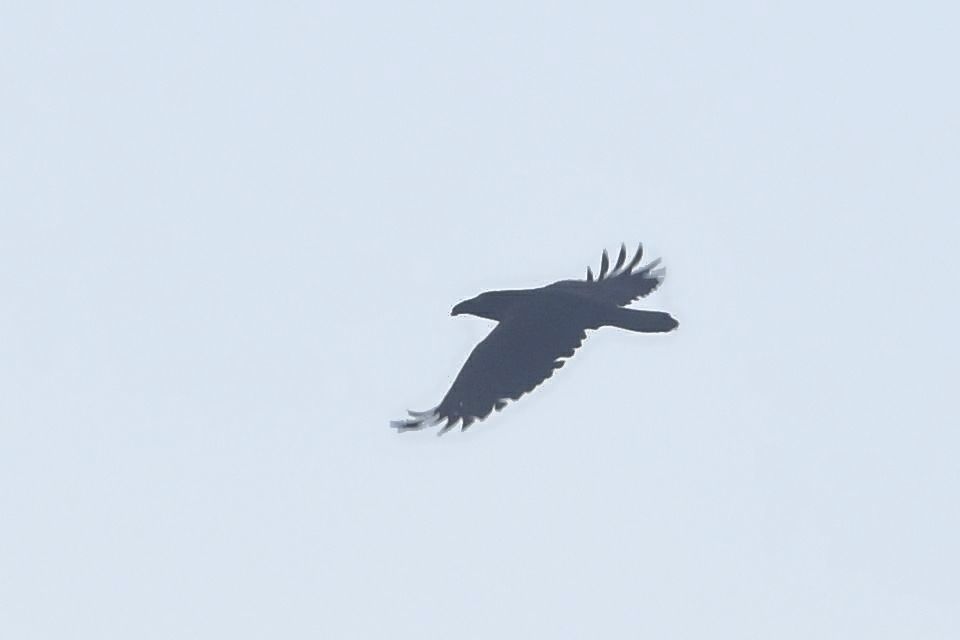
Today was headlined by my first decent find of the year up at Flamborough - a Raven. This monster corvid is rare as hens teeth on the Yorkshire coast although this is the second record in two years at Flamborough. I am led to believe there are just a handful of other records from the site. I was walking up to North Dykes hoping for the Hoodie or some Golden Plover in a field when amongst a monster flock of Rook I heard 'kronk kronk'. It sounded like Raven but the cynical bit of my brain cut in and said it'll just be Rooks doing impressions. I scanned to see a giant corvid slinking over the field being escorted by two Carrion Crows. In the mist it wasn't a great view but with the call I put it out on the local grapevine and on twitter. Despite living in a Raven desert I am fortunate enough to see and hear these impressive beasts on a weekly basis in Somerset, Northumberland and Scotland but it was the juxtaposition that had me on the hop.

Photos by Andy Hood. Thanks Andy!

After this I failed to reconnect but I got the word out and the regulars were scouring the head and it was heard not long after I left by Phil C before being found on the deck at Flatmere. All and sundry were then able to twitch it including Andy Hood who was stuck at work initially but got away just in time. Big thanks to him for letting me use his photos. I didnt have my camera on me as it was drizzling pretty much the whole time I was out and about.


Aside from 'da bigg crow' there was what felt like a quiet seawatch but it had small numbers of wildfowl moving of 7 species including 2 Gadwall, 1 Dark-bellied Brent and a Goosander which were year ticks at Flam. A couple of Dunlin south were also new as were the plethora of Puffins bimbling about and a couple of Lesser Black-backed Gulls. Rather more embarrassingly were tonnes of Meadow Pipits which were displaying everywhere. A trip to Thornwick Pools produced nothing of note as the regulars including the Pochard were all present and correct.

Monday, 6 March 2017

Cirl One Out

This is a little bit of a catch up post after a series of adventures and odds and sods over the last few weeks. It is illustrated with thanks to Pete Clark who has a new camera and now knows how to use it and yet he is still happy to share his photos with me.


So lets start with the Cirl Buntings. Working with Pete and Paul on an infrastructure job in the South-west we found ourselves with the afternoon off after an early start. Our original plan to see the Slapton Ley Humpback went up in smoke when it promptly did one so we went to Torbay to attempt to catch up with wintering seabirds and passerines. A swift transit from Somerset to Broadsands was only interrupted by a Subway stop for Paul and further sustenance for the remainder who fancied actual food. Annoyingly unforecast rain put a dampener on things as did a sea fret which obscured the bay. A Chiffchaff sparked up giving the 'swee' call. It looked like a colybita so thats what it was ascribed to as was its more conventional calling friend. After half an hour we were somewhat bunting-less and hiding in the bandstand when we noted lots of Chaffinches and Linnets in the stubbles. Soon we were seeing buntings and before long at least eight Cirl Buntings were seen foraging on the deck before coming to sit in the small trees by the beach. Great views were had and they were Paul's first UK ones so everyone was happy.

As the buntings lost their lustre we turned our attention to the sea where the only grebe was of the Great Crested variety and shared an empty bay with a somewhat forlorn looking Razorbill. We then focused on trying to find a Firecrest, Yellow-brow or Sibe chiff in the trees around the back car park only to find a singing Cirl Bunting, a standard Chiff and a duo of Goldcrests. Not quite what we were looking for but handsome enough.

We upped sticks and shifted to Brixham harbour, desperately trying to re-enact our visit of three years prior when 30+ Great Northern Divers shared the water with 8 Black-throats, a banana bill, 2 tysties, 2 slavs, 2 Red-necked Grebes and an Iceland Gull. Just outside the harbour on that occasion amongst a further flotilla of GNDs was Clet the Bottlenose Dolphin, famous for trying to shag Irish swimmers. This time however there were two Purple Sandpipers and a very dead Gannet.


The following day we worked rather later and thus had less leeway for adventure so slipped into the Quantocks for our constitutional. A Great Grey Shrike had been wintering not more than 6 miles from our B&B (the wonderful Blackmore Farm in Cannington - go there, its great) and an update from Brian Hill in the morning convinced us that Pointless and the Chase should be forgone for a few hours searching the upland heath for this bandit. Several Ravens, Peregrines and Red Deer later and Pete found it on a bush as we spread like a net over the valley to ensure it didn't evade our attention. Good views were had, if a little distant, but it was evident that the sun was going to emerge so we did a loop to get on the bright side of our mini-murderer. Pete managed to stalk it with patience and get some reasonable shots with the new camera without it ever getting close but it was well lit so some suitable souvenirs have been saved.


Not illustrated was yesterdays jaunt to Flamborough. I slept through my initial opportunity to add Puffin to the PWC yearlist but rather than sulk I decided to do a walk of the south side of the outer head, returning via Old Fall hedge and plantation. My first Coltsfoot and Red Dead-nettle flowers of the year were seen around the headland car park but little of ornithological interest. I moved stealthily along the cliff top when I finally managed to share the same space and time as the wintering male Black Redstart. Suitably dumbstruck I failed to record this with any sort of photography before it made its escape down the cliff. Indeed whilst it felt spring-like this was very much the highlight of my walk as the only other migrants noted were a band of 23 Wigeon on the sea and a brace of Rock Pipits flying over Old Fall plantation. A rather horny woodpecker was knocking seven bells out of the Sycamores in the aforementioned plantation but no female was in evidence. I moved on in search of brownie points by taking a trip to the dump and completing my flatpack duties.

Today I head to Perth for a somewhat different job which hopefully will reacquaint me with the Nazguls of the Spruce plantations as they perform their seasonal display flights. Paul is my travel companion on this occasion and we stopped off en route to check up on the wintering Black Scoter at Cheswick Sands. It was very much not in evidence but this didn't harm a beautiful Northumbrian scene with mountainous dunes providing the elevation to scan through the exceedingly choppy surf. There were plenty of wildfowl riding through the white horses and two Great Northern Divers were the first thing I laid eyes on. Several hundred scoter were offshore but none appeared to be anything other than the common or garden variety although the brevity of the views hindered our attempts as the swell rolled in. We did see several smaller flotillas of Long-tailed Duck totaling over 30 birds with associate Red-throated Divers, Red-breasted Merganser and Eider. We chalked up a brace of Slavonian Grebes just offshore amongst the duck leaving us content if a little chilly round the edges.


Our final adventure was from three weeks ago when Pete, Paul and myself went in search of Bitterns at Ham Wall. We failed but the Great White Egret roost was pretty cool with five birds in one tree as a horde of Starlings descended on the reedbed. The afternoon was finished with the scene below of a Great White Egret crossing a golden lacquered sky to join its kin aside the reedbed. Superb times in an ethereal location.

Tuesday, 21 February 2017

Flamborough PWC

This morning I made my first visit to Flamborough for a few weeks and a special effort was made to catch up with the flock of Lapland Buntings which have been showing to all and sundry over the last week. There was nowt doing initially but I added Great Crested Grebe, Yellowhammer, Goldcrest, Goldfinch and Great Spotted Woodpecker to my #PWC2017 efforts. West of Booted Gully produced a few Skylarks and Linnets as well as a Corn Bunting which flew west out of the field and then alighted on trees at South Landing before continuing towards South Dykes.


I relocated to the field east of Booted Gully and a couple of littoralis Rock Pipits were foraging in the ploughed field, one of which showed a nice pink throat. Eventually a single Lapland Bunting called and then circled the field, presumably looking for the remainder of the flock before disappearing beyond the brow of the hill. I moved onto North Landing to check out the Pochard/Tufted Duck combo which have been in residence, both of which should be tricky to catch up with. There was also a bonus pair of Shelduck ensconced although these weren't needed for the year after a quintet which flew north in January.


So I borrowed Pete's new camera

Pete needed showing how to use his new camera...


Saturday, 11 February 2017

Double dish

Last Friday I was doing some work in Druridge Bay on a realignment site. It was blimin' chilly and I was glad of the conclusion after seeing very little. Afterwards I thought it would have been rude not to check out the Pacific Diver at Druridge Bay country park. The light was appalling but despite this I picked it out at the Eastern end by the outflow from the lake and made my way round. There was a small crowd as it fished constantly between the reedbed and outflow giving great views of its distinctive jizz and more subtle fieldmarks. It showed a definite routine of stick its head up above the water post dive and then slowly bring the body to the surface, followed by a brief cogitation followed by some odd angles with the head and then a half leap of a dive.


This was my second Pacific Diver after the first record at Knaresborough and whilst the weather was grim and the excitement didnt really reach those levels, the views were much closer meaning that a better assessment of the bird could be undertaken in the field. The bird is still present as I type so I may get another chance to view in better light. Hopefully it moults into the outstanding summer plumage whilst present.


I shot off home realising that if I was sharp I may have a shot at the Pine Bunting in Dunnington, near York. A reasonable journey time gave me a two hour window at the bunting. I was initially with a crowd of perhaps a dozen at the south end of the paddock which contained approximately one million Yellowhammers but no icy version. Those surrounding didn't seem overly bothered but I could see a couple of birders at the north end looking intently so I relocated up there.

One of the birders was Chris Gomersall who found the bird inbetween scouring the tip at Rufforth for Caspian Gulls. Chatting to him he thought the bird had a routine and had been seen twice already in the willows at the north of the paddock and he was confident it would again. Plenty of passerine interest was present with Brambling and Siskin amongst the yammers but the larger flock stayed distant.

Time ticked by and confidence ebbed with the other birder, wandering into the next paddock. Dusk was just minutes away when Chris yelped - 'its just landed in the tree, its the only bird'. We got about 20 seconds of excellent views before it disappeared, presumably to roost with its citron brethren. This was a new bird and I was delighted that perseverance paid. It was number 313 for Yorkshire which is ok I guess and a goodie for sure.

Thursday, 2 February 2017

Cattle Egret at Huntspill

With this years influx of Cattle Egrets I have been looking out for one with the Little Egrets that roost around Huntspill since the autumn. Pete got lucky on our last visit with a flyover bird at Combwich in January after he found a bird in Devon late last year. I finally got lucky yesterday as an egret flew across the A38 at dawn and its mechanical, quick flaps and awkward shape attracted attention and as it came out of silhouette an obvious yellow beak was seen. Pete was in the passenger seat and we both jumped to the same conclusion after the I pointed the bird out.

Largely forgetting about the Egret I cracked on with my survey work near the Huntspill sluice and I was joined by a couple who were trying to get photos of the Avocet flock. After an hour in which they were only rewarded with Redshank and Dunlin on the closest bit of mud I heard some tinkling trills of a passerine which I instantly knew was the Snow Bunting which has been doing the rounds between Burnham and Huntspill. The bird dropped in 10 yards up the path onto the rock armour and posed briefly before crossing the track and foraging for over and hour in the margins.


On leaving we noted a load of egrets in pastures which prompted a quick scan and the second bird had a blunt yellow bill. Sadly we had a queue of cars behind us so no time for snaps but it was seen by a number of locals in the afternoon.

Paul and myself moved onto Shapwick Heath and Ham Wall hoping for a few new bits and pieces. In the car park I bumped into the photographers who I saw earlier in the day and mentioned the Cattle Egret to which the woman of the couple said she had some photos and promptly found the bird amongst the throng of its Little Egret relatives in the pictures. Kicking about the reserve we failed to connect with anything of interest aside from five Great White Egrets.

Saturday, 14 January 2017

#Snowmaggedon 2017

Yes, we too had 1cm of snow which rocked our world in East Yorkshire. The screaming North-westerlies however offered seawatching potential but alas access to the head was limited by powerlines that were down over Lighthouse Road. I headed to South Landing instead, looking for sheltering birds and hoping for a white-winger or two. Arriving mid-morning there was already a mixture of birds present but there was very little passing - perhaps too soon after the blow started?

The Seawatching Pod
When it comes to the birds it wasn't sensational but there was plenty of decent stuff hiding away. Headlining was a Great Northern Diver which roamed between the dykes and South Landing. Also out there were 19 Common Scoter, a drake Eider and a plethora of Shags, Cormorant and five Red-throated Divers as well as my first Razorbill from three visits. My score marched onto 56/66 for Patchwork Challenge.

How birds and brains become mutually exclusive

Record, share and compare with BUBO Listing at www.bubo.org